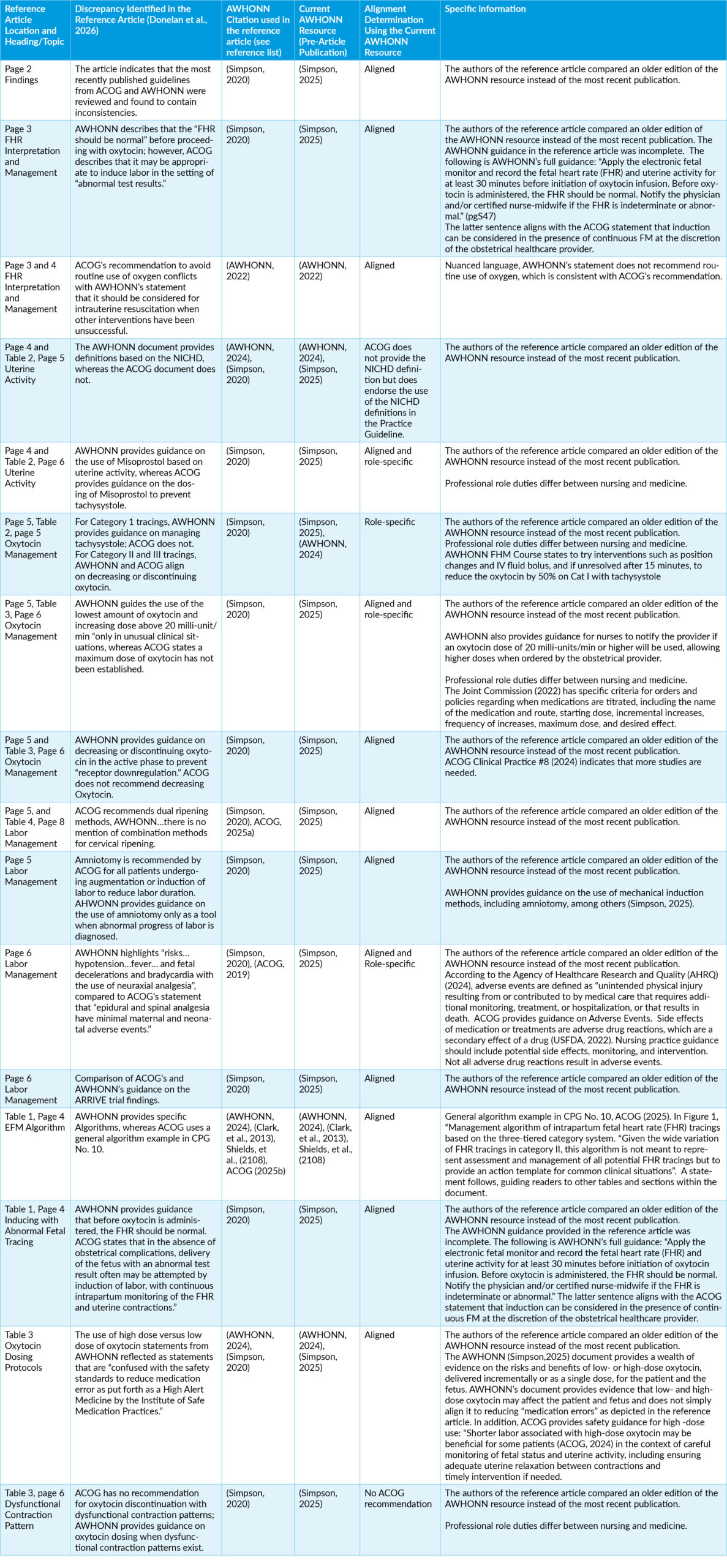
Crosswalk Table: AWHONN Guidelines and the Donelan, et al. (2026) Discrepancy Article Correction
The following table provides a crosswalk of the discrepancies identified in Donelan, E.A., et al. (2026). Professional Guideline Discrepancies as a Barrier to Labor Progress and Teamwork. Obstetrics & Gynecology, 147(3), 313-327.
Preface: The Crosswalk Table provides a synopsis of the discrepancies identified in the reference article above, which was written using an older version of AWHONN’s Cervical Ripening and Labor Induction and Augmentation Monograph (5th Ed) (2020). The crosswalk below identifies the page and topic heading, the discrepancy identified in the reference article, the AWHONN references cited in the article, the current AWHONN references that should have been included in the article, and specific information to alleviate any confusion at the bedside. It is important to identify several key points to help mitigate future articles that may cause confusion or discord within the healthcare team.
Authors of articles must follow rigorous tracking of resources all the way through publication. It is best practice to communicate with professional organizations to assess revision cycles of published resources. Editorial teams should establish a process for reevaluating articles brought to their attention during the pre-release phase. Prior to the reference article publication in March of 2026, AWHONN published the 6th edition of the Cervical Ripening and Labor Induction and Augmentation Monograph in August of 2025. The reference article was accepted and published after the publication of AWHONN’s 6th edition resource. In addition, the Green Journal editorial team was notified of the inaccuracies resulting from the use of an expired AWHONN publication in January 2026.
As with any professional organization practice guideline, there may be overlaps between editions and versions that are updated in accordance with acceptable professional standards, in this case, every 5 years. AWHONN follows these guidelines to ensure that the nursing profession has current, up-to-date information to guide practice. Nursing practice is inherently collaborative, requiring partnership with physicians, midwives, and patients to ensure safe, evidence-based care. In the article, ACOG guidelines and AWHONN monographs and courses were compared as evidence-based recommendations. However, there is a difference in how these resources are intended to be utilized. Varied resources should support—not silence—open dialogue, fostering psychologically safe environments where clinicians can share expertise and engage in informed, patient-centered decision-making. Optimal outcomes depend on respectful, interdisciplinary communication and shared decision-making grounded in mutual recognition of each discipline’s expertise and a commitment to high-functioning teamwork.